
Shweta Agrawal: Healing Through Code | Building with Heart in the Age of AI
When Shweta Agrawal was young, she wanted to become a neurosurgeon. She dreamed of changing people’s lives by understanding the most complex organ of all, the human brain.
“I was fascinated by how powerful and intricate the brain is,” she said. “I wanted to help people, by saving their lives and to heal them.”
But there was one problem: she fainted at the sight of blood!
“I realized I couldn’t become a neurosurgeon,” she laughed. “So, one door closed…and another opened.”
That other door led her to technology and, eventually, to artificial intelligence.
 From Medicine to Machines with Meaning
Shweta did not abandon her dream of helping people, she simply found a new way to do it.
Today, she’s an AI product leader, designing and launching products that solve real human problems.
“Just like a good doctor who diagnoses and treats patients, I do it with empathy, understanding people’s pain points, diagnosing what’s not working, and designing solutions that bring real relief”
She says AI has become her scalpel – a way to extend care and understanding at scale.
“AI is my engine for scale,” she said. “ It gives me sharper tools to understand users, personalize experiences, and scale impact”
Redefining What ‘Healing’ Means in AI
For Shweta, the turning point came when she began noticing how noisy and confusing the AI landscape had become and how thousands of tools are launching every month, all claiming to be “AI-powered.”
“Founders were struggling to figure out what was real, what was ethical, and how to stand out,” she explained.
Instead of contributing to the noise, Shweta decided to focus on responsible design, by building AI that doesn’t just function, but feels human.
“I didn’t want to be another voice in the crowd,” she said. “I wanted to create a framework for responsible, impactful AI.”
That conviction led her to work with founders and startups using AI for social good – including one building a digital companion for trauma survivors.
“We designed guardrails to ensure the AI companion responded with compassion, not just information,” she said. “You can’t automate empathy, but you can build it in.”
She also helped a healthcare startup streamline medical record systems, freeing doctors from administrative burdens so they could spend more time with patients.
“AI should give people their time back to focus on what truly matters,” she said. “It should amplify care, not replace it.”
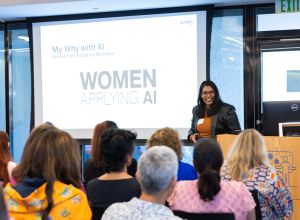
Her ‘Why’ with AI
For Shweta, AI isn’t about automation, it’s about amplification.
She said “My why with AI is about empowering people to focus on creativity, connection, and care.”
Just as she once dreamed of performing brain surgeries that healed the mind and body, she now builds technologies that heal workflows, bridge gaps, and return humanity to systems that often forget it.
Shweta Agrawal’s journey is a proof that purpose doesn’t change, it evolves. She may not wear a white coat, but through her work, she continues to heal others in powerful and transformative ways. Only now, her instruments are lines of code and her mission is clear: To make AI more human – one product, one principle, one act of care at a time.