
Michelle Heath is teaching her AI agent to think like her
Michelle Heath – My Why with AI
Part of the “My Why with AI” series by Women Applying AI
The marketer and author of Unrivaled – Five Steps to Achieving Explosive Business Growth is building an AI assistant to explore questions her earlier tools put out of reach, drawing on the experience and judgment she brings to customer research.
Michelle Heath was complaining about someone who wasn’t getting it. The work wasn’t coming together. Her husband came in, heard her frustration and wanted to know who she was talking about. Was somebody about to be fired?
Michelle was talking about GIA, the Growth Intelligence Agent she is building. Michelle works with this AI assistant every day, and she talks about it with the familiarity of someone discussing a colleague. There are good days. There are days when GIA gets stuck and Michelle has to work out how to ask the question differently.
“I’m trying to help her think human,” she says.
Her why: Understanding customers better
Michelle’s reason for using AI is rooted in the work she really cares about: understanding customers. She wants to explore questions and connections she could not easily investigate before, with an agent shaped by her own experience and judgment. Teaching GIA how she thinks is part of that effort. The larger ambition is to understand the people her clients are trying to reach more deeply.
Michelle’s work involves helping businesses figure out what makes them distinct and why a customer might choose them. She follows questions that revenue figures and customer counts cannot answer on their own: What is someone worried about? Why are they hesitating? What would make them decide? Why do they buy – or more importantly, why not?
In her work with her clients, Michelle was early in the AI learning curve, helping disruptive AI companies for about a decade before she began trying the tools herself. She was used to things changing rapidly in Marketing, though she remembers a time when getting through a big shift felt like an accomplishment. Now, she more or less expects something to change every day. With so many tools competing for her attention, she was trying to decide which ones deserved her time. She considers herself a “thinker-doer”, meaning she rolls up her sleeves not just consulting and advising but actually using the tools her clients are using. This unique perspective gives her clients more than just a fractional CMO as she partners with them to solve burning growth challenges.
Putting her experience into GIA
Looking at the volume of generic AI writing, she began wondering whether she could use what she had conveyed in her book, Unrivaled, to make an agent useful in her own client work. She wanted something she could think with, drawing on the ideas she had already spent time developing.
Michelle had built a few websites, but she had never coded. A workshop helped her get started with Claude Code, which she is also using to build GIA. She has been figuring things out along the way, turning to people in the Women Applying AI community when she needs help. Sometimes she asks GIA itself how to build what she has in mind.
“Instead of trying to come up with how to do it on my own, sometimes I’ll say to GIA, how should we build this?”
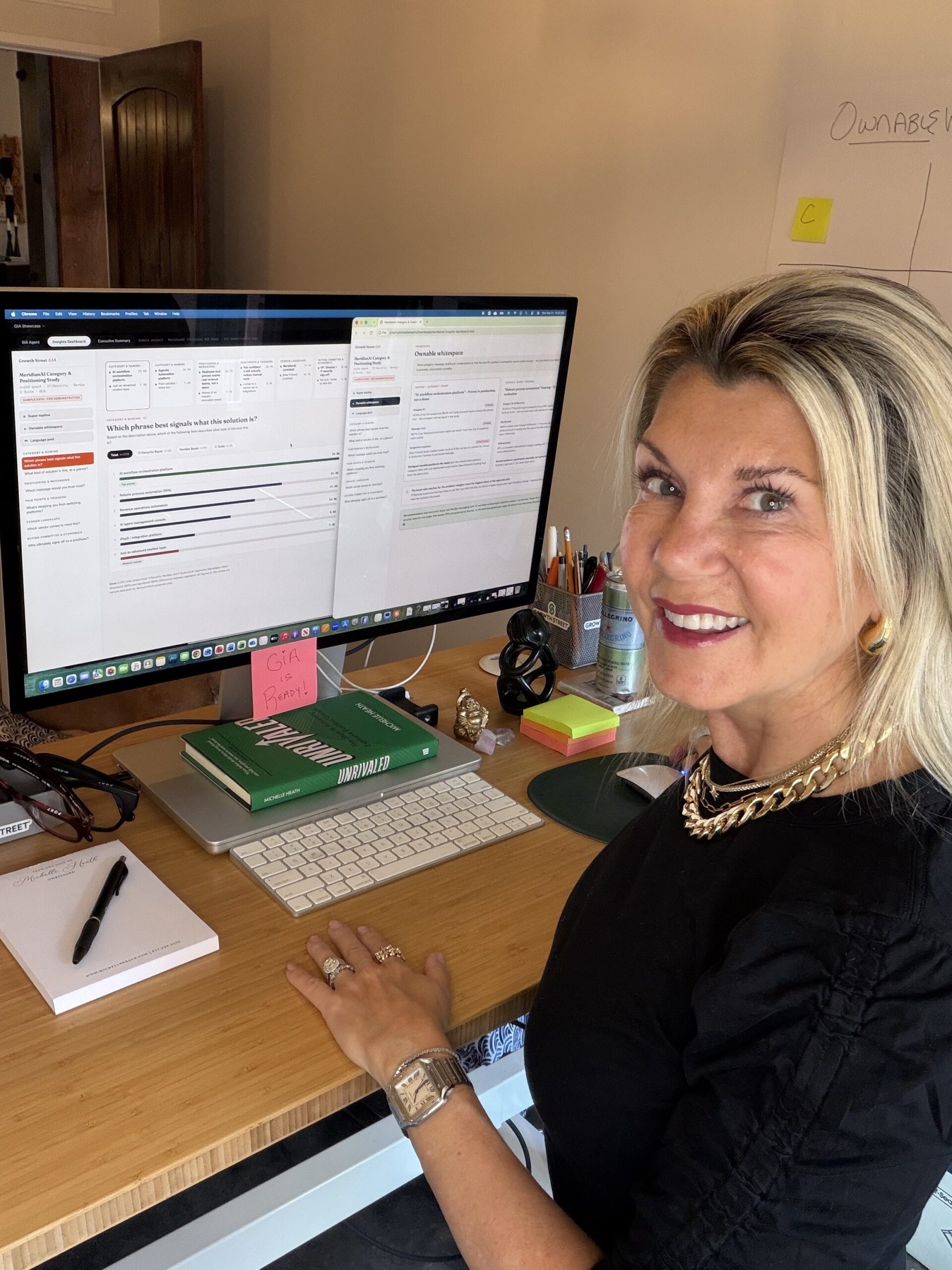
On a market category and positioning strategic engagement, Michelle has been using GIA as a thinking partner for an intense customer research piece of the project. Comparing different slices of the data and turning the findings into charts and a dashboard – she is pushing GIA to not just compile data but to go beyond to find the nuances and threads that tie the strategy together. Having a new way to look at the data more closely, she says, has helped her surface insights and make strategic connections without needing the data analytics and coding expertise of the quantitative software. Instead of relying on others to do the heavier analytical work, she is building and training GIA, removing the barrier that once stood between her and that work.
The data still needs an interpretation
When asked what she has been able to offload to AI, Michelle corrects the premise: “It’s helping me do my job better.” The value is in the questions she can now pursue and the connections she might otherwise have missed.
For the customer research project, GIA already had the data – files of cross-tabs, raw data and verbatims. What would have taken weeks to organize, now takes hours (or less!). It has made the charts and the dashboards more impactful and she has her fingers on the data at all times. Michelle needed to prepare a recommended strategic direction for an executive leadership team, and asking GIA to start that story seemed reasonable. But the result was not up to her “unrivaled” standard. It’s one thing to have the data and materials, it’s yet another to build a compelling story for the C-Suite. Having the material had not been enough to produce the explanation she needed.
Sometimes Michelle steps away. Sometimes she starts a new chat within the project and tries again from a different place. She is still working out how much direction is enough, and when more conversation is no longer helping. “Prompting is an artform,” she says. “Luckily, in my role, I am used to being curious and asking questions to go deeper and find the answers. AI gives me a way to code by prompting.”
She recalls another piece of analysis in which GIA treated a finding as a reason not to proceed. Michelle challenged GIA’s thinking as she saw another possible interpretation that the AI agent couldn’t see. AI can be very black and white. She asked GIA to consider the alternative analysis. GIA said, “That’s a great point, I didn’t think of it that way.”. She often questions what GIA makes of the data and whether there’s another way to read it. That’s the human in the loop element that makes AI better.
Michelle wants GIA to share some of her own disposition: curious, kind, optimistic, always looking for ways to do things better. But she is also finding out how much of that outlook she has to supply, question by question, prompt by prompt.
For now, she is GIA’s only user. While it’s not ready for prime-time, she can see the power of giving people access to a thinking partner like GIA. “My clients are getting the behind-the-scenes benefit of GIA in my work and the results are helping us move faster with strategic accuracy. Giddy up!”

Michelle Heath – My Why with AI